How to Prepare for CSS Exam in 6 Months – Complete Study Plan
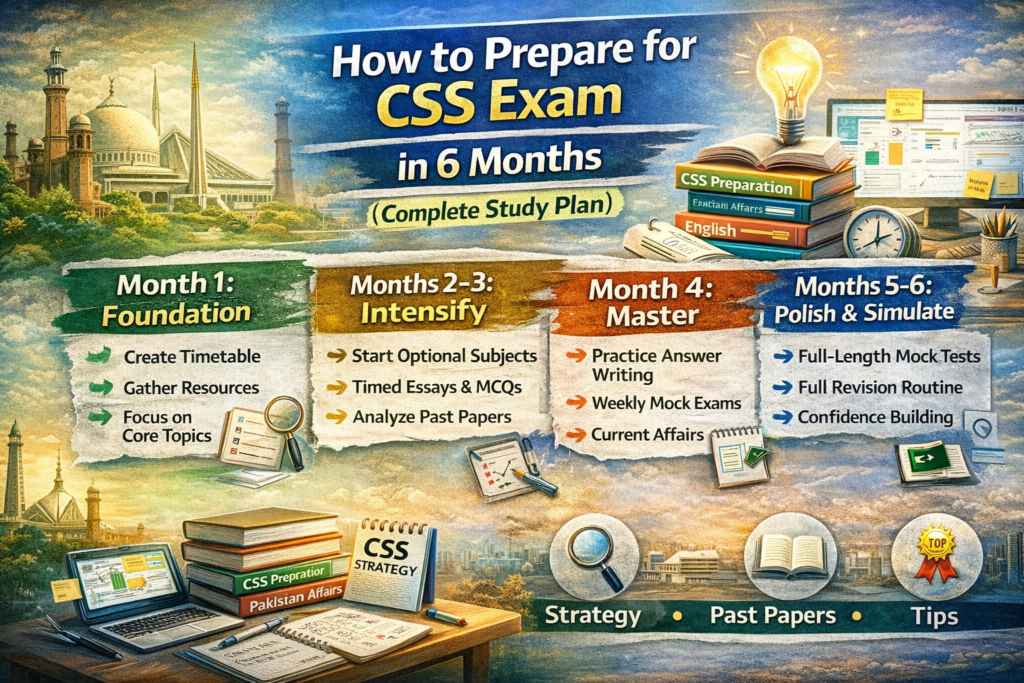
Prepare for CSS Exam in 6 Months CSS is not just an exam.
It is a decision.
A decision to give one year of your life to something uncertain. A decision to compete with thousands of brilliant minds across Pakistan. A decision to test your patience more than your intelligence.
And here is the truth nobody tells you:
Six months are enough.
But only if you stop preparing randomly.
This guide is not motivational talk. This is a practical, ground-level, realistic 6-month CSS study plan — built for serious aspirants who don’t have 2–3 years to “figure things out.”
If you follow this properly, six months are more than enough.
Let’s begin.
First: Understand What CSS Really Demands
Before planning months, understand the battlefield.
CSS checks:
- Your analytical ability
- Your written expression
- Your general awareness
- Your mental stamina
- Your consistency
It does not reward:
- Ratta system
- Random academy notes
- Social media “topper strategies”
CSS is a writing exam.
If your writing is weak, your knowledge will die inside the answer sheet.
So your 6-month plan must focus on:
- Content building
- Answer writing
- Revision
- Mock practice
Not just reading books endlessly.
The Reality of 6 Months
Six months mean approximately:
- 24 weeks
- Around 180 days
- Roughly 1,000–1,200 serious study hours
If you study:
- 6–7 hours daily (focused, not fake sitting time)
You can cover:
- All compulsory subjects
- All optional subjects
- 3–4 revisions
- 10–15 full-length mocks
But only if your planning is structured.
Now let’s break it month by month.
Month 1: Foundation Phase
This is your most important month.
If you waste this, the rest collapses.
Step 1: Understand the Syllabus Deeply
Download official FPSC syllabus.
Print it.
Read every line.
Underline important areas.
Most students skip this and directly buy books. Big mistake.
The syllabus is your map.
Without a map, even hard work becomes confusion.
Step 2: Choose Optional Subjects Wisely
Optional selection can make or break you.
Don’t choose based on:
- Friend’s suggestion
- Academy pressure
- “High scoring” rumors
Choose based on:
- Your background
- Your interest
- Availability of material
- Overlap with compulsory subjects
For example:
- Political Science overlaps with Current Affairs
- International Relations overlaps with Pakistan Affairs
- Sociology helps in Essay and General Science
Smart selection reduces workload.
Step 3: Start Compulsory Subjects
In first month, focus mainly on:
- Essay
- English Precis & Composition
- Pakistan Affairs
- Current Affairs
Start building writing habit immediately.
Daily task:
- Read one newspaper editorial
- Write 200–300 words summary
- Improve vocabulary
This habit alone can transform your English paper.
Month 1 Goals:
- Finalize optional subjects
- Complete 50% of Pakistan Affairs
- Build daily newspaper habit
- Write 5 short essays (1000 words each)
No perfection. Just discipline.
Month 2 & 3: Content Building + Optional Subjects
Now intensity increases.
These two months are heavy.
You will feel pressure.
That’s normal.
Strategy for Compulsory Subjects
Continue:
- Daily newspaper
- Weekly essay writing
- MCQs practice
Start:
- Islamiyat (with references)
- General Science & Ability
Make short notes.
Not 100-page notebooks. Just crisp bullet points.
CSS rewards clarity, not decoration.
Strategy for Optional Subjects
Divide optional subjects across 8 weeks.
Example:
Week 1–2 → Optional Subject 1
Week 3–4 → Optional Subject 2
Week 5–6 → Optional Subject 3
Week 7–8 → Optional Subject 4
Finish one subject completely before moving.
Solve past 10 years papers after each subject.
Past papers are gold.
They show patterns.
CSS repeats themes, not exact questions.
Writing Practice (Very Important)
From Month 2 onward:
Start writing full-length answers.
Take a past paper question.
Set 35 minutes timer.
Write complete answer.
Then evaluate:
- Did you address the question?
- Did you give arguments?
- Did you conclude properly?
Writing speed + structure = marks.
Month 4: Consolidation Phase
By now:
- Syllabus should be covered once
- Notes should be ready
- Weak areas identified
Now shift from reading mode to exam mode.
Focus Areas:
- Essay Structure Perfection
- Current Affairs analytical writing
- Answer presentation
- Quotations and references
Start writing:
- One full essay weekly
- Two past paper questions daily
Practice introductions and conclusions.
They create first impression.
Improve Presentation
Your answer must have:
- Clear headings
- Logical flow
- Arguments with examples
- Diagrams (where relevant)
CSS examiner checks hundreds of copies.
Make yours easy to read.
Month 5: Mock & Revision Phase
Now real game begins.
Stop reading new books.
Start revising.
Full-Length Mock Tests
Give:
- 2 essays
- 2 precis papers
- 4–5 subject mocks
Sit 3 hours.
No phone.
No breaks.
Simulate real exam environment.
You must train stamina.
CSS is mental marathon.
Revision Strategy
Use 3-step revision:
- Read short notes
- Revise headings only
- Recall without looking
Active recall strengthens memory.
Passive reading wastes time.
Month 6: Final Polishing Phase
Last month is not for panic.
It is for calm confidence.
Now:
- Revise all subjects 2–3 times
- Practice past paper questions
- Improve weak areas
Don’t experiment.
Don’t change optional subjects.
Don’t buy new books.
Trust your preparation.
Daily Study Routine (Practical Model)
If you study full-time:
Morning (3 Hours)
Compulsory Subject
Afternoon (2 Hours)
Optional Subject
Evening (2 Hours)
Current Affairs + Writing Practice
Night (1 Hour)
Revision
Total: 7–8 serious hours
Consistency beats motivation.
Common Mistakes to Avoid
- Over-collecting books
- Ignoring English writing practice
- Delaying optional selection
- Not solving past papers
- Studying without timetable
CSS is strategy exam.
Random study fails.
Best Books Strategy (General Guidance)
Do not read 4 books per subject.
One main book + past papers + your notes.
Too many sources create confusion.
Clarity is power.
How Many Essays to Practice?
Minimum:
- 20 full essays before exam
Essay is 100 marks.
It decides your fate.
Take it seriously.
Current Affairs Preparation Strategy
Instead of memorizing news:
Understand issues.
For example:
- Economy
- IMF
- CPEC
- Climate change
- Regional politics
Prepare issue-based notes.
CSS asks analytical questions.
Not headlines.
How to Improve English Fast?
Daily:
- Read editorials
- Learn 5 new words
- Write short paragraphs
- Practice precis weekly
English improves with writing, not watching lectures.
Mental Preparation Matters
You will feel:
- Self-doubt
- Comparison anxiety
- Fear of failure
Ignore noise.
Focus on daily targets.
Six months discipline can change your life.
Is Academy Necessary?
Not mandatory.
If you are disciplined, self-study works.
Academy helps only if:
- You need direction
- You lack structured approach
Otherwise, self-study + past papers are enough.
Final 10-Day Strategy Before Exam
Last 10 days:
- Revise short notes
- Practice outlines
- Sleep properly
- Stay calm
Don’t overload brain.
Confidence is half success.
Final Thoughts Prepare for CSS Exam in 6 Months
CSS is not about genius.
It is about:
Consistency.
Structure.
Writing skill.
Smart planning.
Six months are enough if you:
- Follow syllabus
- Practice writing daily
- Revise multiple times
- Give mock exams
Stop waiting for perfect moment.
Start today.
Because preparation does not begin with books.
It begins with decision.